


The Best Time to Do a Hair Transplant Before Getting Married is usually 9 to 12 months before the wedding, so hair matures naturally in photos.
Timing is very important when considering a hair transplant before getting married. The ideal time frame depends on multiple factors. The surgery itself typically takes one day. However, recovery and the development of transplanted hair take longer. Because hair grows in cycles, planning matters if you want your wedding photos to reflect your final outcome. If you want a general medical overview of the procedure itself, see hair transplantation.
According to the International Society of Hair Restoration Surgery, hair grows in cycles. After a transplant, most patients experience a shedding phase often called shock loss, and then growth resumes gradually. If you schedule a hair transplant too close to your wedding, your photos may capture the “in-between” stage, not your final density.
The general 12-month timeline after a hair transplant
- 1st month: shock loss starts
- 3rd to 4th month: new growth starts to show
- 6th month: hair density has started to improve
- 9th to 12th month: full results are noticeable
By scheduling your hair transplant well in advance, you give your hair time to mature so it looks natural on the wedding day.
How Many Months Before a Wedding Should I Schedule a Hair Transplant?
It is recommended that you schedule your hair transplant 9 to 12 months before your wedding. Many clinics also consider 6 months the minimum acceptable window if you understand that results are still developing.
12 Months Prior to Wedding: The Ideal Time Frame
If you schedule your hair transplant 12 months before your wedding, you allow plenty of time for the transplanted hair to grow, thicken, and mature.
Benefits of scheduling a hair transplant 12 months prior to your wedding:
- You will have a wide variety of hairstyles to choose from
- There will be no visible redness around the hair transplant site
- The hair will have developed a mature texture
- The hairline can be refined
- The process is less stressful because you are not racing the calendar
9 Months Prior to Wedding: An Excellent Time Frame
Scheduling your hair transplant 9 months prior to your wedding still gives you substantial time for growth and visible density. In wedding photos, most people will simply see fuller hair, even if maturation is still continuing behind the scenes.
6 Months Prior to Wedding: The Minimum Time Frame
Yes, you can have a hair transplant 6 months prior to your wedding, but growth is still in progress. At six months, density can improve substantially, and the hair begins to form a workable hairstyle. However, thickening continues beyond this point, which is why 6 months is the minimum, not the ideal.
3 to 4 Months Prior to Wedding: Not the Best Time
A hair transplant 3 to 4 months before a wedding carries real risks for photography. At that stage, you may still be experiencing shock loss, early uneven growth, and incomplete density. That makes it the least reliable window for a major event.
What Happens If I Wait Too Long Before My Wedding?
Hair transplant recovery cannot be rushed. Research indexed on PubMed consistently reflects that follicles follow a biological growth cycle.
Possible short-term effects that can occur if you cut the timeline too close include:
- Temporary redness
- Mild swelling
- Small scabs that last around 7 to 10 days
- Shedding of transplanted hairs
- Patchy early regrowth
These are typically temporary, but they can affect engagement photos, pre-wedding events, and confidence during the weeks leading up to the wedding.
Time Frame for Recovery From a Hair Transplant
How long does it take for a hair transplant to fully grow and thicken?
Understanding the phases of healing helps you plan realistically.
Phase 1: Month 1
The scalp heals and transplanted hair enters the normal shedding stage (shock loss). This shedding is expected.
Phase 2: Months 2 to 3
The follicles are alive, but growth is mostly dormant. Changes may be minimal on the surface.
Phase 3: Months 4 to 6
New growth begins. Early hair can look thin at first, but it is gaining strength.
Phase 4: Months 7 to 9
Density increases noticeably. Texture improves and styling becomes easier.
Phase 5: Months 10 to 12
Final results become clear. Hair reaches maximum thickness and density, and transplanted hair tends to remain more resistant long-term.
Do Men and Women Need Different Wedding Planning Strategies?
Yes. Hair growth timing is similar, but the goal of restoration often differs.
For men
- Hairline design is essential
- Temple restoration adds balance to the face
- Beard transplant timing may also matter for some grooms
For women
- Preserving existing density is often the priority
- Avoiding additional thinning from aggressive harvesting matters
- Working between existing hairs is often important in diffuse thinning cases
Why Consider Clinique de Monsieur for a Wedding Hair Transplant?
Clinique de Monsieur focuses on precision, low trauma, and natural results that look correct in close-range photos. If you are considering a wedding timeline, the key advantage is planning with your calendar in mind, not just booking a procedure.
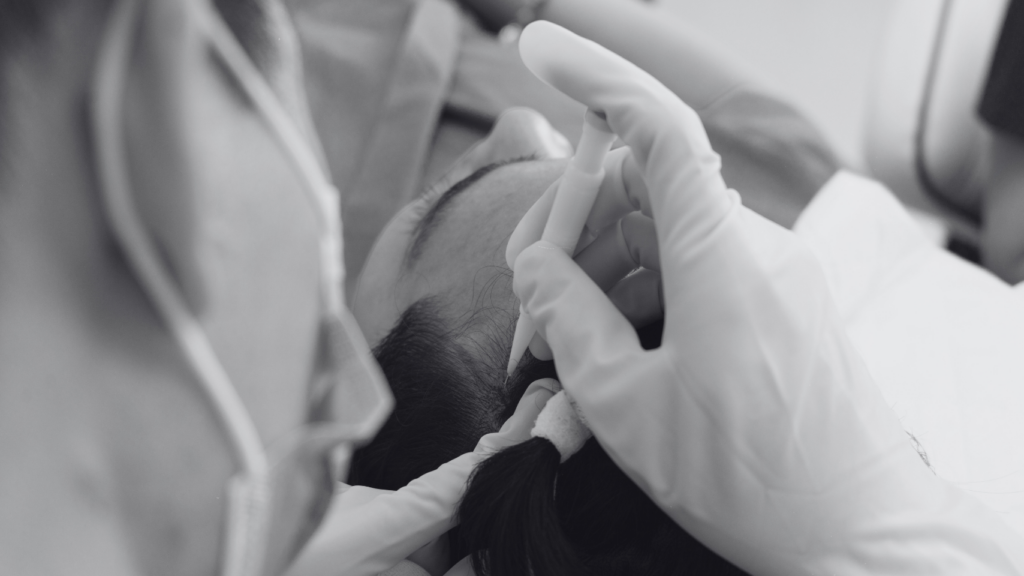
At Clinique de Monsieur, Direct FUE is used when appropriate, with positioning that supports discretion and graft viability: grafts are implanted immediately after extraction to reduce time out of the body, often using an implanter pen to control angle, depth, and direction, with maturation typically progressing over 8 to 12 months.
If you want to learn more about this approach, see Direct FUE.
Can PRP Help If I Am Running Out of Time?
If your wedding is too close for a full transplant timeline, PRP can temporarily support hair quality and thickness.
PRP benefits can include:
- Stimulating dormant follicles
- Increasing hair shine and texture
- Decreasing shedding
- Supporting early growth
PRP is not a substitute for surgery in advanced hair loss, but it can complement a plan, especially when time is limited.
Checklist for Planning a Wedding Hair Transplant
How can I plan strategically?
- Book a consultation 9 to 12 months prior to your wedding
- Select an experienced hair transplant surgeon
- Plan timing so it does not interfere with honeymoon travel
- Follow post-operative instructions carefully
- Avoid aggressive hairstyles during early recovery
- Consider PRP treatments 2 to 3 months before your wedding
Planning early reduces stress and increases the chance that your wedding photos capture your best result.
Realistic Expectations for Your Wedding Day Photos
Wedding photos capture detail from every angle and under harsh lighting. If you plan correctly, you can realistically expect:
- A natural-looking hairline
- Density that appears in photos
- Balanced facial proportions
- Greater hairstyle flexibility
- Increased confidence on camera
Conclusion
What Is the Best Time to Have a Hair Transplant Before Getting Married?
Timing is one of the most important factors in achieving a result that looks great in wedding photos. The best planning window is 9 to 12 months before your wedding, with 12 months being the least stressful option. At 6 months, results can be visible, but they are still developing. At 3 to 4 months, the risk is highest because growth is early and may not look complete in photos.
If you are planning a wedding and want a discreet, doctor-led timeline, book a consultation with Clinique de Monsieur. You will receive diagnosis-guided planning, a realistic schedule built around your wedding date, and when appropriate, a Direct FUE approach designed for natural-looking results as your hair matures over the coming months.