


Introduction
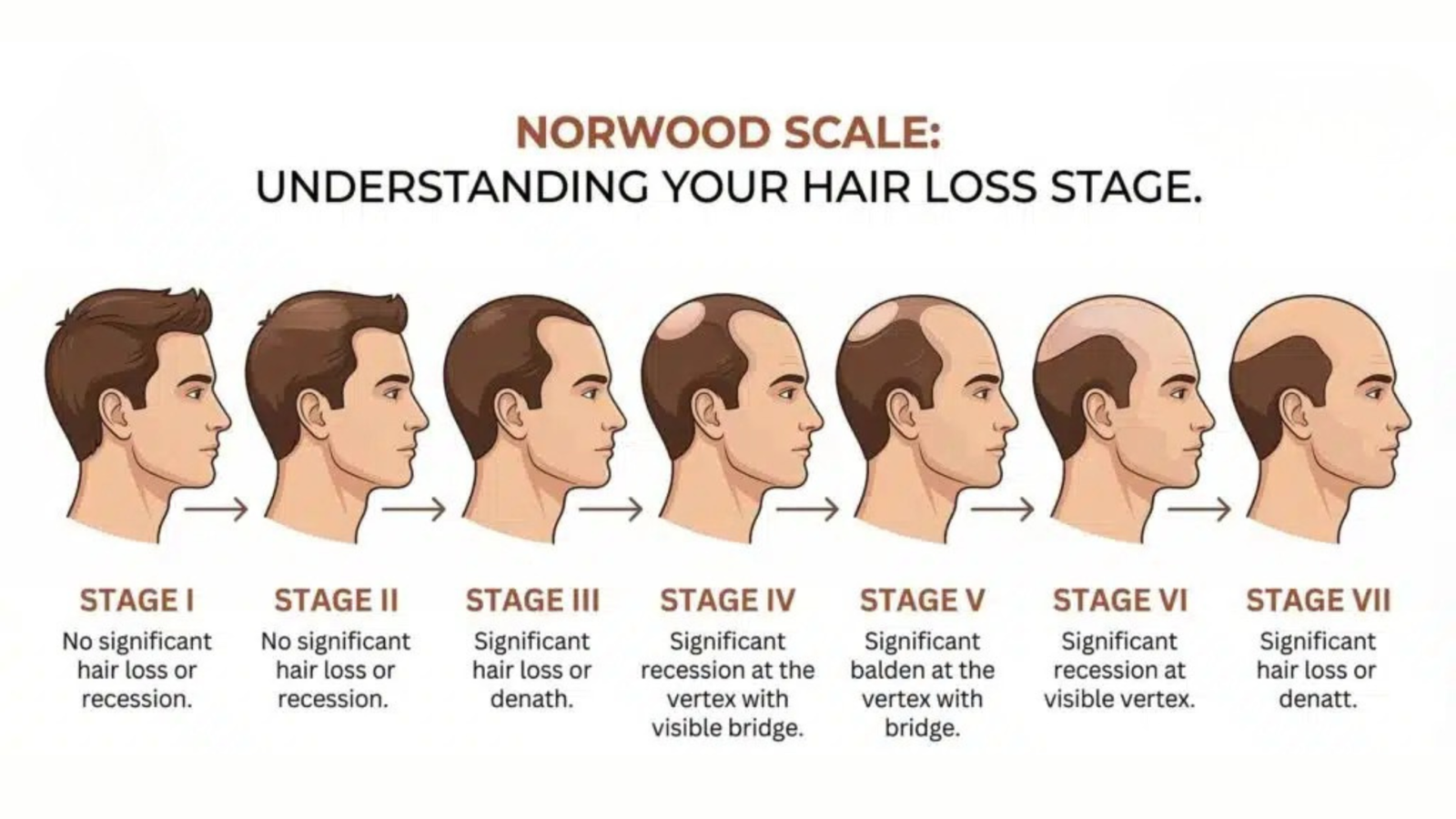
Male pattern baldness is the most common form of hair loss among men. When you begin to notice a change in your hair line or density, you might find yourself wondering about the progression of male pattern baldness and what stage you’re at right now. The Norwood Scale is the most commonly used classification system for male pattern baldness and will help both the patient and his doctor to better understand the progression of hair loss.
At Clinique de Monsieur, we utilize the Norwood Scale to assist us in developing an accurate, personalized treatment plan. In addition, our team utilizes state of the art techniques such as Direct FUE. Grafts are being placed using the Choi implanter, providing very precise placement and resulting in very natural looking hair transplants.
This article explains what the Norwood Scale is, how male pattern baldness develops throughout its various stages, and which type of treatment options would work best at each stage.
What Is the Norwood Scale?
What Is Represented by The Norwood Scale?
The Norwood Scale represents a universally accepted way to classify and measure the degree of androgenetic alopecia, also known as male pattern baldness, in men. The Norwood Scale is utilized by doctors and other health care professionals to identify the amount of hair loss a man is experiencing and forecast his potential rate of hair loss.
Why Do Doctors Use the Norwood Scale In Their Practices?
Doctors utilize the Norwood Scale because it gives them a solid foundation upon which they can evaluate the patterns of hair loss. As a result, when selecting treatment options for hair loss, doctors are able to provide recommendations based on the patient’s present stage of hair loss.
Primary uses of the Norwood Scale are
- To assess the extent of hair loss
- Track the progression of hair loss over time
- Guide treatment planning
Why Is the Norwood Scale Significant?
Why Should You Know Your Norwood Stage?
Knowing your Norwood stage enables you to make educated decisions regarding treatment. Without knowing your Norwood stage, it is difficult to choose the right course of action.
How Does Knowing Your Stage Affect Treatment Choices
Every stage calls for a different treatment strategy. For example
- Preventative treatments for early-stage patients
- Combination therapy medical and or surgical for moderate stage patients
- Surgical procedures for advanced stage patients
Identifying your stage early will produce better results for you in the long run.
What Are the Different Stages of The Norwood Scale?
How Does Hair Loss Occur During the Different Stages?
Hair loss does not develop rapidly. On the contrary, it generally occurs gradually and according to a somewhat predictable sequence in most males.
What Are the Major Stages of Hair Loss?
- Stage I
Little to no hair loss visible - Stage II
Small recession at the temples - Stage III
More pronounced recession or early crown thinning - Stage IV
Noticeable hairline recession and crown thinning - Stage V
Expanded areas of hair loss with reduced density - Stage VI
Crown area disappears - Stage VII
Advanced hair loss with limited donor area
While there are many similarities in how hair loss progresses among men, there is considerable variation in terms of both speed and degree of hair loss.
Does All Men Experience Hair Loss at The Same Rate?
Do All Men Experience the Same Pattern Of Hair Loss?
There are some variations. Although the Norwood Scale serves as a basic framework for classifying and measuring male pattern baldness, each person experiences hair loss differently.
Which Factors Contribute to Differences in Hair Loss
Factors contributing to differences in rates and degrees of hair loss among men are
- Genetics
- Dihydrotestosterone DHT sensitivity
- Lifestyle habits
Why Does This Matter
Because every person has unique characteristics. Thus, every person must receive personalized evaluations. As a consequence, personalized treatments will generate better results than generic ones.
How Is My Norwood Stage Evaluated?
How Can I Figure Out My Stage?
A healthcare provider will visually examine your scalp, check your hair density, and review your medical background to accurately assess your particular stage on the Norwood Scale.
Why Is Professional Evaluation Of Your Stage Important?
Self-diagnosis may be inaccurate. Therefore, professional assessments guarantee that your treatment plan will be correctly developed and executed.
Which Treatments Match Up Best with Each Stage
Will Treatment Change Depending on Your Stage?
Yes, and this is possibly the single most significant factor affecting your hair restoration treatment.
Early Stages I To II
At these stages your objective is to prevent further loss and stabilize your existing hair.
Moderate Stages III To V
By this point you are going to need to incorporate more extensive measures into your treatment regimen.
Advanced Stages VI To VII
At these later stages strategic thinking becomes much more critical.
Why Is Direct FUE So Well Suited to Every Stage of The Norwood Scale
What Makes Direct FUE So Suitable for Any Stage of Hair Loss
Direct FUE is one of the leading-edge methods available today for performing hair transplantations. It allows for both extremely precise extraction of grafts from donor sites and also controlled placement of those grafts back onto recipient sites.
How Does Direct FUE Enhance Results
Using Direct FUE and placing grafts with the aid of Choi implanter provides for
- Grafts will be placed with extreme precision
- Minimize damage to surrounding skin
- Enhanced survival rates for grafts
What Are the Key Advantages of Direct FUE?
- Quick recovery times
- No linear scarring
- Very natural looking dense coverage
For these reasons patients are able to enjoy both short term aesthetic improvements and long-term success.
The Clinique de Monsieur Approach to Treating Patients with Hair Loss According to Their Norwood Stage
What Sets Our Clinic Apart from Others?
At Clinique de Monsieur we blend art and science together to create stunningly realistic results.
How Does Your Team Personalize Treatment Based Upon a Patient’s Stage?
When treating patients with hair loss due to either genetic predisposition or hormonal imbalance our clinic employs
- Comprehensive evaluation using the Norwood Scale
- Customized treatment plans
- Controlled management of the donor site
- Use of Direct FUE
We also employ Choi implanter to place grafts with extreme precision maximizing both graft survival and natural appearance
Why Must Treatment Be Tailored to Each Individual Case
Each person has distinct characteristics. Therefore, a custom fit approach produces better and more realistic results than generic alternatives.
Conclusion
What makes the Norwood Scale such an important tool in understanding and managing hair loss
It provides a clear and structured way to understand how male pattern baldness progresses over time. More importantly it allows both patients and specialists to make informed decisions about treatment based on each specific stage. While hair loss is common its progression is not identical for everyone which makes personalized evaluation essential.
Moreover, achieving optimal results depends on early diagnosis proper planning and the use of advanced techniques. With Direct FUE where grafts are being implanted with the use of Choi implanter precision natural appearance and long-term success are significantly enhanced.
At Clinique de Monsieur our goal is to deliver refined natural and long-lasting results through personalized treatment strategies and advanced technology.
Ready To Understand Your Norwood Stage
We invite you to schedule your personalized consultation and discover the most effective solution tailored to your needs with Clinique De Monsieur.