



Introduction
How does a doctor decide how many hair follicles to extract during a hair transplant procedure? This is probably one of the most common questions from potential patients before the procedure. While the answer is not just a simple number, it is based on medical evaluation, aesthetic planning, and the creation of a personalized plan for each patient.
At Clinique de Monsieur, our doctors provide a high level of precision and expertise in every case we undertake. In this article, we will describe the method our doctors use to calculate the number of hair follicles required for a successful hair transplant, the factors they take into account, and the importance of proper planning to achieve the most natural and long-lasting results.

What Are Hair Transplant Follicles and Why Are They Important?
What is a hair follicle?
A hair follicle is referred to as a follicular unit, meaning a group of hair follicles that naturally grow together. A follicular unit may contain:
• 1 hair follicle
• 2 hair follicles
• 3 to 4 hair follicles
Therefore, when doctors talk about follicles, they are referring to groups of hair follicles and not individual hairs.
Why are hair follicles important in hair transplantation?
Hair follicles determine the final success of a hair transplant. More specifically, they affect:
• Hair density
• Coverage of bald areas
• Natural appearance
Based on the above, 2,500 follicles can produce 5,000 to 6,000 hairs. Therefore, understanding follicles is essential for estimating results.

What Factors Are Considered in Graft Calculation?
Does the extent of hair loss affect calculation?
Yes, it is the first and most important factor. Doctors evaluate hair loss using the Norwood Scale to determine the stage of androgenetic alopecia.
• In early stages, fewer follicles are required
• In advanced stages, more follicles are required
Therefore, patients with extensive hair loss require strategic distribution of follicles.
You can explore the classification through the Norwood Scale.
How does the donor area affect the number of follicles?
The donor area usually refers to the back of the head. This is where follicles are extracted from. Doctors evaluate:
• Hair density
• Follicle strength
• Skin elasticity
Also, overharvesting must be avoided. For this reason, calculations are made within safe limits to protect long-term hair health.
Does hair type affect the number of follicles?
Yes. Hair type plays an important role.
• Thicker hair provides better coverage and requires fewer follicles
• Finer hair requires more follicles for the same density
• Curly or wavy hair provides greater visual density
Additionally, the contrast between hair color and skin color affects perceived density.
What density do doctors aim for?
Instead of aiming for maximum density everywhere, doctors aim for strategic density.
Typically:
• 40 to 50 follicles per cm² for the hairline
• 30 to 40 follicles per cm² for the mid-scalp
• Lower density for the crown area
This approach creates a natural and balanced result.
How Do Doctors Calculate Follicles Step by Step?
Step 1: Scalp and hair analysis
Initially, the doctor performs a detailed examination that includes:
• Digital density measurement
• Donor area evaluation
• Hair thickness analysis
At the Clinique de Monsieur, we use modern equipment for accurate results.
Step 2: Measuring the thinning area
Next, the doctor measures the area in square centimeters. This is crucial, as the number of follicles depends on the size of the area.
Step 3: Hairline design
At this stage, the question arises: where should the new hairline begin?
Doctors consider:
• Facial proportions
• Age
• Natural growth patterns
Proper design contributes to a natural appearance.
Step 4: Follicle calculation
The basic formula is:
Area size × desired density = total number of follicles
For example:
50 cm² × 40 follicles per cm² = 2,000 follicles
However, the number is adjusted for each patient.
Step 5: Final adjustment
Finally, the doctor adjusts the number by considering:
• Future progression of hair loss
• Donor area limits
• Long-term planning
The number is always personalized.
How Does Direct FUE Affect Follicle Calculation?
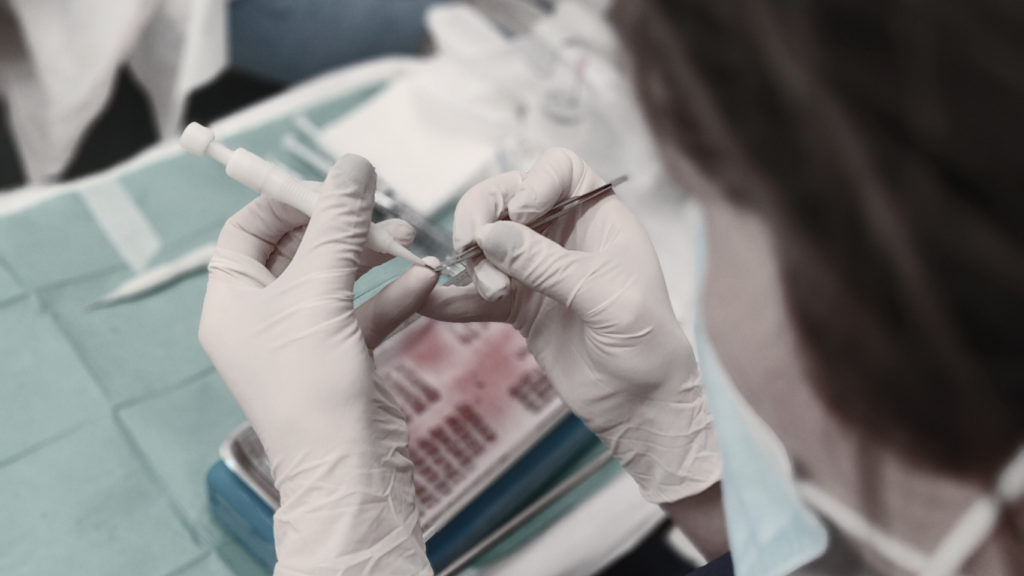
Direct FUE is an advanced technique where extraction and implantation of follicles are performed almost simultaneously, as grafts are being implanted with the use of a Choi implanter. This reduces the time follicles remain outside the body.
What is a follicle?
A follicular unit is a group of hair follicles that naturally grow together and may contain:
• 1 hair follicle
• 2 hair follicles
• 3 to 4 hair follicles
During a Direct FUE hair transplant, each graft is extracted from the donor area and implanted into areas of thinning or baldness using a Choi implanter, ensuring precision and natural results.
Direct FUE is an advanced technique where extraction and implantation occur almost simultaneously. This reduces the time follicles remain outside the body.
Does Direct FUE affect the number of follicles?
Yes.
• Follicles experience less stress
• Survival rates are higher
• Placement is more precise
Therefore, fewer follicles may be needed for better results.
How Many Follicles Are Needed per Stage?
Can we estimate?
Yes:
• Norwood 2 to 3 → 1500 to 2500 follicles
• Norwood 3 to 4 → 2500 to 4000 follicles
• Norwood 5 to 6 → 4000 to 6000+ follicles
• Crown only → 1000 to 2500 follicles
Why Is Accurate Calculation Important?
What happens if too few follicles are used?
• Thin result
• Incomplete coverage
• Possible need for repeat procedure
What happens if too many follicles are extracted?
• Donor area damage
• Visible thinning
• Limited future options
How does proper calculation help?
• Natural density
• Even distribution
• Long-term success
What Makes Clinique de Monsieur Différent?
Why choose a personalized approach?
We combine:
• Medical expertise
• Technology
• Aesthetic design
How do we ensure results?
• Detailed consultation
• Personalized plan
• Long-term strategy
Conclusion
So, how does a doctor determine the number of follicles?
It is clear that this is much more than a simple estimation. Doctors evaluate hair loss patterns, assess donor area capacity, measure the scalp, and create a personalized plan.
Ultimately, accurate follicle calculation is the foundation of a successful hair transplant. It ensures natural density, protects the donor area, and delivers long-lasting results.
At Clinique de Monsieur, we combine science and aesthetics to create personalized plans for every patient.
Book your consultation today and receive a personalized follicle calculation tailored specifically to your needs.