



Introduction
What is the right age for men to undergo a hair transplant? Is it better at 25, at 30, or after 40? Many men notice hair loss very early and look for a permanent solution. However, the success of a transplant is not based only on technique. It depends mainly on the right timing, an accurate diagnosis, and a restoration strategy that protects your future options. This guide explains the most suitable age for hair transplantation, clarifies when it is too early or too late, and highlights the factors that influence long-term results. We also answer key questions many men have before moving forward.
At What Age Is a Hair Transplant Possible?
Can a hair transplant be done before 25?
Technically, hair transplantation can be performed from the age of 18. But is it wise to make that decision so early? In most cases, no, because androgenetic alopecia has not stabilized yet. As a result, the future course of hair loss remains uncertain.
In addition, if hair loss continues, asymmetry can appear or a second transplant may become necessary. For this reason, specialists often recommend waiting until there is a clearer picture of progression.
What are the risks of a very early transplant?
Let’s look at the likely consequences of proceeding too early:
- Hair loss may continue behind the new hairline
- An unnatural aesthetic result may occur
- The donor area may be depleted too early
- The likelihood of needing a second procedure increases
That is why choosing the right timing helps secure the best possible outcome.
What Is the Best Age for a Hair Transplant in Men?
Is 30 the most suitable age for a hair transplant?
Usually, yes. Most specialists consider the best age range for hair transplantation to be between 30 and 45. By that time, the progression of hair loss is typically clearer, which allows for a natural hairline design and a result that lasts.
Why does this age range often produce better results?
- Androgenetic alopecia has reached a more stable stage
- The donor area can be evaluated more reliably
- Planning is based on expected future progression
- The final result looks more natural and holds long-term value
This creates the right balance between aesthetics and long-term sustainability.

Which Factors Show You Are Ready for a Transplant?
Age matters, but it is not the only factor. A responsible decision requires multiple criteria.
Has hair loss stabilized?
If hair loss remains aggressive, the result may not stay stable long-term. That is why stability is assessed before the final decision.
Donor area quality
Success depends on donor density, hair quality, skin elasticity, and graft availability. Without a strong donor area, the final result may be limited.
What stage of androgenetic alopecia are you in?
We use the Norwood scale to understand the level of hair loss, likely progression, and the right strategy. Therefore, correct diagnosis is essential before any treatment. For scientific information on androgenetic alopecia, you can refer to the American Academy of Dermatology.

Hair Transplantation in Younger Men and When It Can Be Appropriate
Is a hair transplant possible at age 25?
Yes, but only under specific conditions: when hair loss has stabilized, when there is significant psychological burden, when a conservative hairline design is applied, and when there is a long-term restoration plan. Even then, it requires experience and strategic planning.
A different approach is required for younger patients
For younger patients, we prioritize donor preservation, a naturally evolving hairline, and the option of a second session later. This is how we secure a sustainable, natural result.
Is There an Age Limit for Hair Transplantation?
Is a hair transplant possible after 50?
Yes. Age alone is not a limiting factor. Many men over 50 achieve excellent results when the appropriate medical criteria are met.
What we evaluate in older patients
We assess overall health, donor quality, medical history, and realistic expectations. For medical information about hair transplantation, you can review the International Society of Hair Restoration Surgery.
Why Personalized Diagnosis Matters More Than Age
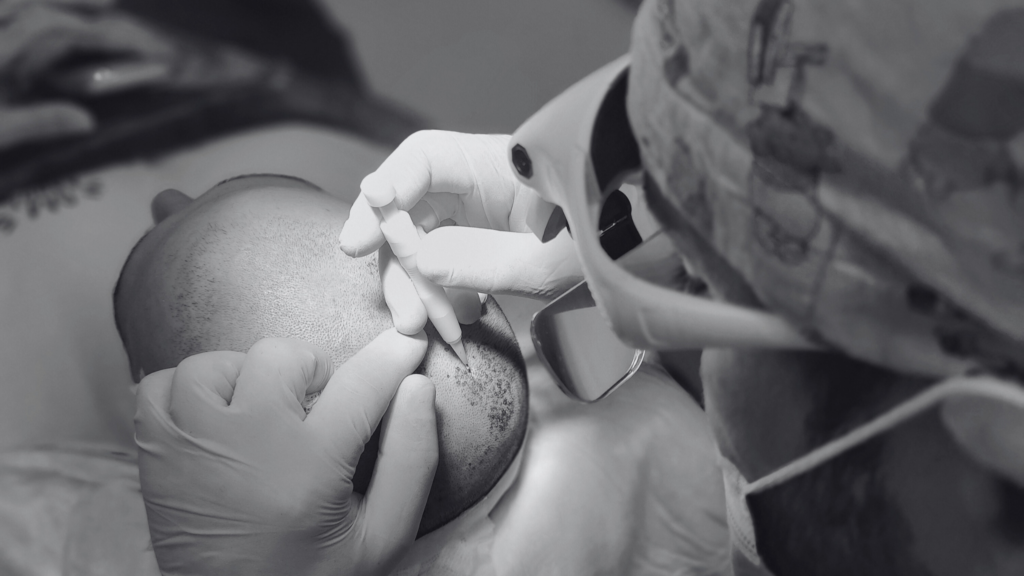
A successful hair transplant does not depend only on age. It requires a complete, in-depth evaluation.
What a proper diagnosis includes
- Detailed trichoscopy
- Donor area examination
- Planning for future progression
- Medical guidance
- Long-term strategy
Conclusion
There is no single universal answer for the right age for a hair transplant in men. Ages 30 to 45 are often the most suitable, but the final decision depends on hair-loss stability, donor quality, and correct planning. Hair transplantation is a medical procedure that requires expertise, strategy, and a personalized approach. Proper diagnosis leads to better long-term results and a more natural restoration.
If you want a doctor-led assessment and a long-term plan designed around your age, donor capacity, and likely progression, book a consultation with Clinique de Monsieur. When appropriate, the clinic may recommend Direct FUE, with immediate implantation after extraction and implanter-pen control for angle, depth, and direction, as results mature over 8 to 12 months.